What Happened
France, October 11 to 12
CERT-FR, which published the first version of its alert on October 12, reports numerous compromises of remote refrigeration controllers. The manufacturers pointed to old equipment. Danfoss said many affected units had reached end of life or were running outdated firmware, Reuters reported, and Copeland said the vulnerability was in "a discontinued, end-of-life generation of controllers," according to AP. Using the Shodan scanning service, Reuters found at least 4,500 Danfoss interfaces still viewable on October 13.
On November 9, France attributed the attack to Shahid Kaveh after an investigation by the C4, which brings together France's national cybersecurity agency (ANSSI) and its intelligence and defense agencies. Paris prosecutors have requested international arrest warrants, ANSSI said.
Europe, November 1 to 2
The EU Agency for Cybersecurity (ENISA) said the incidents had reached "a number of EU Member States" since October 11, and issued joint advice with the European Commission and Europol after the new wave. The CCB said attackers forced units into defrost cycles of up to 50°C overnight, causing "supply disruptions for several European retail chains." In Sweden, ICA said the affected stores' connections sit outside its central network, and Axfood said online grocery home deliveries in Gothenburg were affected, SVT reported. Response teams in 12 EU countries have issued warnings, an EU CSIRTs Network list shows.
Why It Matters
Refrigeration is now a sabotage target
France's foreign ministry called the October attacks the first offensive cyber campaign on French territory carried out purely for sabotage, and described Shahid Kaveh as a persistent threat to France's critical infrastructure. The C4 links the same attack to concurrent targeting of Schneider Electric devices at small hydroelectric installations in France, with moderate effects. According to the C4 report, the group had already claimed a sabotage campaign in March and April 2026 that hit Israeli refrigeration equipment. The FBI says it is seeing these systems "targeted across critical infrastructure sectors globally."
The contractor's link is part of the system
France's national blood service (EFS) said the November 2 attack targeted its refrigeration supplier, not EFS, and raised temperature and defrost settings in cold rooms at three facilities, BleepingComputer reported. Its alarms caught the change, and no loss of blood products has been reported. The official guidance treats that supplier link as part of the fix. CERT-FR and the CCB tell operators to check insurance terms before cutting the data feed to their refrigeration contractor, and allow filtering contractors' IP addresses only as an emergency stopgap. Italy's national cybersecurity agency (ACN) says checks must cover the connections through which users, applications and maintainers reach the control functions.
It reaches beyond supermarkets
In France, the C4 report also lists small butcher shops, a slaughterhouse and cooperative food-processing plants among the victims. The CCB said the second wave targeted cold-storage operations, and the US fact sheet from CISA, the FBI, USDA and two other agencies names cold storage facilities alongside grocery stores. NIS2 covers food businesses engaged in wholesale distribution and industrial production and processing, from medium-sized enterprises up. A depot that shares a refrigeration contractor with its stores shares that contractor's access path.
What It Means for Security Leaders
- Put remote access into the maintenance contract. Name who owns the access, which accounts exist, how changes are logged and who is told when a technician leaves.
- Map every access path. ACN's list includes remote assistance services, cellular routers and connections set up by maintainers, including links between sites, stores and suppliers.
- Design the replacement before you cut the link. ACN says VPN access should not reach every system. For end-of-life units, CERT-FR and the CCB warn that a factory reset is not enough if the device stays exposed.
What Changes With Entropya
The principle for securing remote access to refrigeration controllers applies with any vendor. A controller should have no public address, and a contractor should reach it only through an authenticated session. CERT-FR advises restoring access only through a secure VPN or protected network, and the Entropya Encrypted Network (EEN) is that kind of protected network.
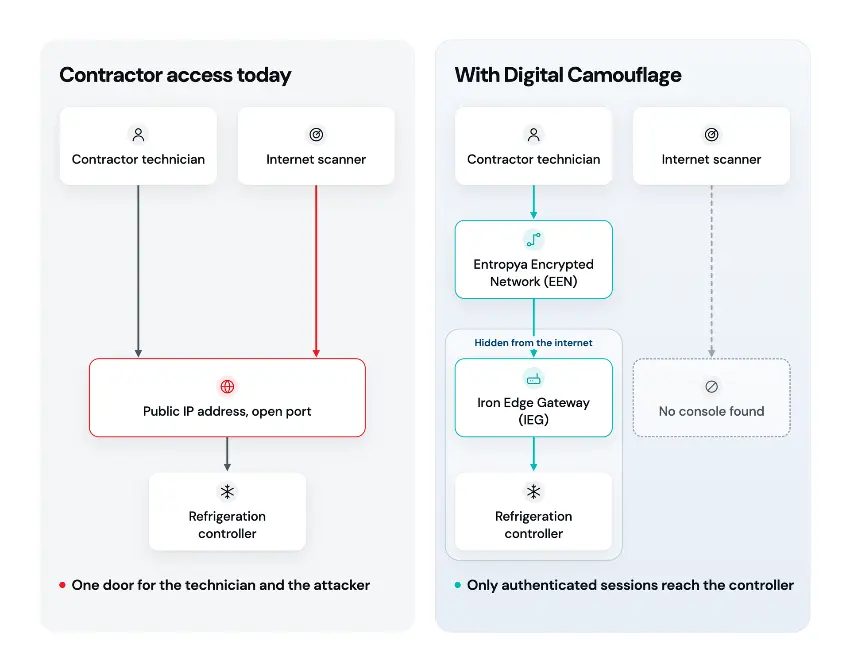
Figure 1. Contractor access today compared with Digital Camouflage
The C4 report says the attackers used the FOFA scanning tool to carry out the attack on French refrigeration systems. Taking systems out of that search is the HIDE pillar of Entropya's HIDE. HARDEN. VERIFY approach.
Digital Camouflage, delivered by the Entropya Encrypted Network (EEN), Iron Edge Gateway (IEG), and Post Quantum Agents, removes exposed IPs, DNS records, and digital fingerprints, so a scan has no target to map.
- An IEG on the site's connection authenticates the controllers behind it into the EEN, and complements or replaces the existing firewall or VPN gateway.
- The technician connects through the EEN, which dynamically authenticates every connection and keeps source and destination separate over randomized, one-way pathways.
- Without PQC credentials held on an IEG or the PQ Agent, an attacker cannot find the network or authenticate into it. Contractors connect with PQC credentials from their own IEG or the PQ Agent, so their side is set up as part of the deployment.
- Monocle, Entropya’s monitoring platform for the EEN, adds intrusion detection and real-time visibility into network connections, and alerts on traffic that matches known attack signatures.
Hiding the controller removes the route to it. Default credentials and outdated firmware still need fixing, as CERT-FR and the CCB advise.
Table 1. Exposures in the refrigeration attacks and how Entropya addresses them
Questions to Ask Your Team
- Which refrigeration controllers in our stores and depots answer from the internet today, including on lines our contractors ordered?
- Does our refrigeration maintenance contract say who owns remote access, and who tells us when a technician leaves?
- If we cut contractor access tonight, which monitoring, warranty or insurance obligations would break?
- Would anyone be alerted if a defrost setting changed at 3 a.m.?
Frequently asked questions
On October 11 to 12, 2026, attackers changed defrost settings on refrigeration controllers at about 700 retail-chain sites in France to high temperatures, causing losses of goods and, in at least 15 cases, fires, according to France's national cybersecurity agency (ANSSI). A second wave on November 1 to 2 targeted supermarkets and cold-storage operations in countries including Belgium, Luxembourg, the Netherlands, Sweden, Ireland and Estonia, according to Belgium's CCB. It also affected refrigerators used by French blood banks, Reuters reported.
On November 9, France's foreign ministry attributed the October attack to Shahid Kaveh, an offensive cyber unit affiliated with the electronic and cyber center of Iran's Islamic Revolutionary Guard Corps. The C4, which brings together ANSSI and France's intelligence and defense agencies, cites characteristics of the attack infrastructure, tools the group is known to use, a relay of the attack by a linked propaganda outlet, and traces of Farsi. The attribution covers the attack in France.
Belgium's CCB says attackers took advantage of unpatched firmware, web interfaces exposed to the internet and default vendor credentials that had never been changed. The Netherlands' national cyber security center (NCSC) says attackers can exploit internet-connected refrigeration systems, including through weak and default passwords. In France, the C4 report says the operators used the FOFA scanning tool. At France's national blood service, the attack targeted a refrigeration supplier rather than the service itself, BleepingComputer reported.
Remove every controller from the public internet and restore remote access only through a secure VPN or protected network, as CERT-FR and Belgium's CCB advise. Change default passwords, keep firmware up to date, use phishing-resistant multifactor authentication wherever feasible, and set setpoint limits with alerts for deviations, as the US fact sheet recommends. Then write ownership of that access into the maintenance contract, so it does not fall between the contractor, facilities and IT.